Showing posts with label diamond clarity. Show all posts

Thursday, September 9, 2010

ADORN SOME FANCY SHAPED DIAMONDS!!

Besides the conventional diamond shapes, there are some unique variety of geometrical shaped diamonds for those who love to explore the unexplored. Unusual shapes of diamonds come in a wide range and these can be converted into custom jewelry that is unique and exceptional. Below listed are a few forms of unconventional forms that one can expect.

  1. TABLET SHAPED DIAMONDS: In these the stone is cut in the form of a tablet, with three straight sides and one end curved. A popular example of this shape is the Ten Commandments diamond which is in the form of a tablet.

  1. TRIANGULAR SHAPED DIAMONDS: These diamonds resemble a prism and have a lot of brilliance. These can be used as solitaires and can also be inlaid in the metal for a simple yet elegant look.
  1. SHIELD SHAPED DIAMONDS: These stones are cut in the form of a shield used in battles as implied by the name.
  
  1. KITE SHAPED DIAMONDS: This is one of the oldest fancy diamond shape known. Its shape resembles a kite. The kite shaped diamond looks better as side stones of a major solitaire.

  1. KISSING SHAPED DIAMONDS: This is another very unusual shape of a diamond which still has to find its way in the market. As the name indicates, the single elongated stone is cut and shaped in a way that it resembles the shape of two lips in a kiss.

  1. HORSE HEAD SHAPED DIAMONDS: These diamonds are in the shape of a horse’s head. They carry exceptional details and high clarity which brings a lot of brilliance and make this shape extremely fascinating. This shape is most suitable for settings in pendants, ear rings and rings. It is a hot seller with horse lovers.

  1. BUDDHA SHAPED DIAMONDS: As is obvious from the name, this diamond resembles a meditating Buddha. It is completely handcrafted and sculpted out from one single round diamond. It is a three dimensional work of art and is associated with lot of charm, class and good luck. It has 56 facets and refracts light in all seven colors of the rainbow.

  1. CHRISTMAS SHAPED DIAMONDS: This diamond is shaped in the form of a Christmas tree. The single round diamond is cut in a triangular shape with roves to give it the shape of a pine tree. Though it is not very popular, such stones can make excellent festive jewelry and they are suitable for pendants and ear rings.

  1. HALF MOON SHAPED DIAMONDS: These stones are in the shape of a crescent. The stone is these are cut straight on one side while the other edge is rounded. Initially these diamonds were cut from broken or cracked round diamonds. Cutting half moon diamonds causes a lot of loss in diamond weight for getting proper brilliance. 
  1. FLORAL SHAPED DIAMONDS: These are very popular and can be obtained either through a solitaire or by clustering small diamonds together. Flower shapes are obtained by using a combination of five fancy cut shapes. These are zinnia, marigold, Dahlia, fire rose and sunflower cut. Unconventional cutting angles are usually employed to obtain maximum brilliance for these diamonds.

  1. LEAF SHAPED DIAMONDS: Leaf shaped diamonds are yet another example of the diamond shapes inspired by the nature. Many small stones in this shape can be set together to give a resemblance of a leaf. Solitaires like the four leaf clover designs titled lucky leaf are quite prevalent in the designer's world too. The maple leaf is also very popular version.

  1. STAR SHAPED DIAMONDS: To give jewelry a festive look, diamonds can also be cut in the shape of a star. Larger diamonds are ideal for star shaped diamonds. They are popular for settings in pendants, bracelets, ear rings, brooch pins and finger rings.

  1. BUTTERFLY SHAPED DIAMONDS: This is beautiful shape that complements the natural beauty of diamonds. Butterfly shaped solitaires look very elegant. Diamonds in this shape can be complemented with other stones for maximum elegance.
 Besides all the above mentioned exceptional shapes of diamonds there are many other fancy shaped diamonds that depend on the designer’s creativity. It is also very important to note that the shape does not affect the diamond’s quality.

Tuesday, March 16, 2010

The Four C’s of Buying Diamonds


Diamonds are the most expensive gem and when shopping for it you need to look at the basic attributes that are highlighted in the diamond's 4C’s – cut, color, clarity and carat.

Cut: A cut defines the facet arrangement of diamond that is further called as Shape. People get confused with cut and shape. But, they are two different aspects of the same coin. Basically, the craftsman shows his skills by arranging the facet of the stone in such a way that the light which enters through diamond should get reflected directly back to the viewer's eye.

Diamond cutters are solely responsible to make or break the light that enters through the stone. Hence, too shallow or too deep cut can cause light to "leak" out from the sides and bottom of the diamond.


GIA has set parameters that evaluate diamond cut and grade them as follows:

* Ideal
* Premium
* Very Good
* Good
* Fair and Poor.

The better the Cut grade, the more expensive is the diamond.

Color: Here the color refers to the transparency of the gem, because colorless diamonds are more valuable than a colored stone. With the exclusion of "fancy colored diamonds", colorless diamonds are very rare and highly in demand. Diamond color has been graded on a GIA scale from D (colorless) to Z (light yellow). 

Clarity: It refers to the internal flaws that are called as inclusions such as small flaws, air bubbles, scratches, tint or other minerals within the diamond. The inclusion of diamond would result on its price. However, diamond with less inclusions is more precious and attractive.


The scale for grading diamond's clarity is:


F Flawless – No inclusions.

IF Internally Flawless - Slight inclusions in the exterior of the gem.

VVS1-VVS2 Very Very Slightly Included - minute inclusions that are very difficult to detect on 10x magnifications loupe.

VS1-VS2 Very slightly included - tiny inclusions, invisible to the naked eye and can only see through the 10x magnification loupe.

SI1-SI2 Slightly included - invisible to the naked eye, yet easily visible under 10x magnifications.

I1-I3 Included - inclusions are visible to the naked eye and affect on its brilliance.

When deciding on clarity, people usually go with SI2 and VS1 diamonds, without knowing their differences. A diamond that falls between VVS2 to F is very rare and expensive so, make sure you select the stone with proper evaluations.

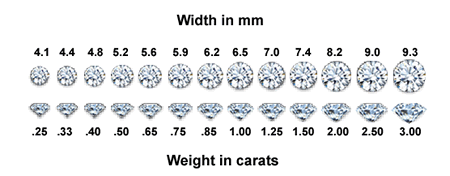
Carat: A carat refers to the size and actual weight of a diamond. One carat is equivalent to 200 milligrams. Carat is also evaluated in numerical values.

For example:

* One carat diamond equals to 100 points,
* One-half carat diamond is consider as 50 points
* Three-quarter carat diamond as 75 points and so on.

Big diamonds are more expensive than smaller one of the same quality because of its rarity. For example: one carat diamond is much more expensive than value of multiple small diamonds of the same quality and total carat weight.

Thursday, January 14, 2010

Loose diamond: How to Gauge the Diamond Clarity?

The formation of a rough diamond begins with extreme heat and pressure to be eventually valued as a precious gem. The intense heat and pressure during the formation of diamond leaves some naturally occurring flaws that are called Inclusions and Blemishes.

The internal scars of the diamond are called Inclusions and the tiny marks that occur on the outer surface of the stone are called blemishes. The inclusion may contain clouds, feathers, cavity while blemishes may contain polishing lines, scratches, pit and chips in the cutting process. These two flaws cause the overall appearance of a diamond and if the flaws are very severe it can disturb the light rays to pass through the surface of the stone that reduces the brilliance.

An inclusion can be easily spotted on the surface of the stone. However, diamond cutter makes possible effort to reduce the inclusion's position on the stone that would reflect back transparency of the stone.

GIA Diamond Clarity Grading-

Diamond clarity grade is viewed under 10x magnification loupe to understand the internal attribute on the basis of size, number, position, nature and colors. GIA has comes up with the standardized method and developed a clarity scale to analyze the inclusion and blemishes in a diamond. This clarity scale is designed to view the number, size, reflectivity, color and position of these flaws. This scale has been globally adopted as means of clarity checking.

GIA grading report shows clarity finding in writing and issues the certificate that passes from the seller to the buyer with diamonds. The certificate shows the grading in terms of the inclusions the diamond has. The position of the internal and external flaws of diamond is clearly described in the report. While most labs follow the GIA taxonomy for clarity, other laboratories such as AGS and EGL do not.

Following are the GIA clarity grades and their definitions-

Flawless (FL) – No inclusions or blemishes are visible when viewed under 10x magnification

Internally Flawless (IF) – No inclusions, only blemishes are visible when viewed under 10x magnification.

Very, Very Slightly Included (VVS1 and VVS2) – Inclusions are difficult to see under 10x magnification.

Very Slightly Included (VS1 and VS2) – Minor Inclusions are noticeable under 10x magnification.

Slightly Included (SI1 and SI2) – Inclusions are clearly visible under 10x magnification.

Included (I1, I2, and I3) – Inclusions are obvious under 10x magnification and may affect transparency and brilliance.

The process of analyzing the diamond clarity can be followed by the above concept that has now been universally adopted by the people. Since, GIA clarity grading scale is specifically designed to make a online purchasing diamond easy, as it would give the buyer an idea about the diamond they are looking for as per the taste, budget & other aspects and can make a firm decision independently by doing proper evaluation of diamond flaws like a professional.
Related Posts with Thumbnails